
B2B is Different!
Two major ways where b2b products are different than b2c

Economics 101 tells us that the market price for a product is set when supply and demand are in equilibrium, in other words when supply equals demand. Theoretically that applies to both individual consumers (b2c) as well as business customers (b2b).
This assumes that the product in question is a commodity. That means that all sellers are selling the exact same product in the marketplace. In this environment it is obvious why being the lowest cost producer is a big advantage. That company can lower its prices below all other competitors, grab most/all of the customer demand and make the most profit.
Meanwhile back in the real world
Things are more complicated in the real world.
Looking at the supply side, most products we buy are not commodities. Why? Because companies choose to make their products unique. That is called differentiation, which is all about being better and not necessarily cheaper than the competition.
Companies seek differentiation because they must. There is room for exactly one lowest cost producer in a market. If you’re not, then you have no other choice. Therefore, the majority of b2c and b2b companies need to compete based on differentiation, not cost.
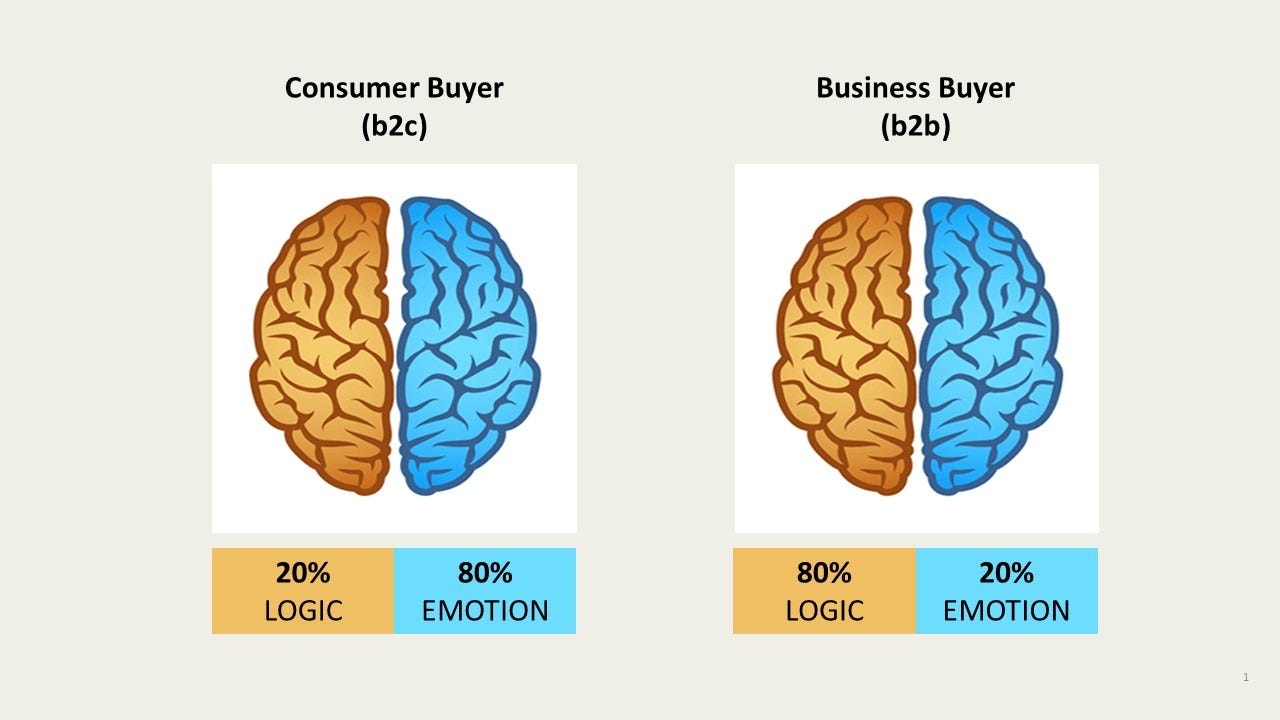
Looking at the demand side, both b2c and b2b customers make buying decisions using the same high-level cognitive functions. This includes both the left-side of the brain associated with logical thinking as well as the right-side associated with creative/emotional thinking.
The similarities end there. The process of decision making is quite different for consumers versus businesses. In fact, the very same individual thinks differently depending on whether they are a consumer or an employee.
Let’s take for example an individual named Fred. He is in the market to purchase a new car for himself while at the same time evaluating a hardware purchase for the company he works for. This comparison is revealing.
Difference #1 - What kind of Differentiation?
Below is a comparison of the internal thought process of a b2c versus a b2b purchase.
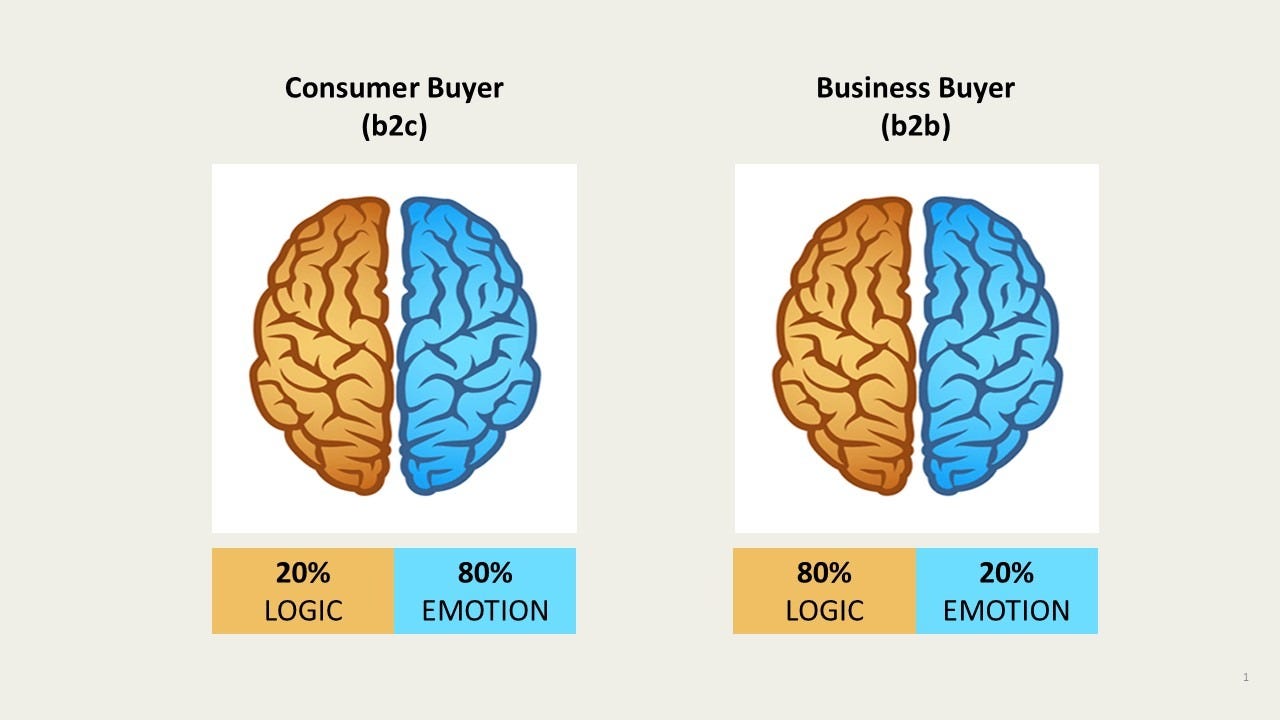
We’ll start with the b2c example (left side of graphic).
When Fred is in the market for a new car, he is likely to have definite opinions of which type of vehicle and specific brands that are based on his personal values, interests, and aspirations. What will the new car say about him? Will his friends and family be impressed? Will it increase his attraction to potential romantic partners?
This is all right-brain activity. The car salesperson knows it. So does the car manufacturer who has spent millions in advertising over years to embed images into Fred’s memory that tap deep into his emotions of acceptance, excitement, and power. Those images and storyline are very compelling to Fred. It differentiates his preferred car brand from all others.
Of course, there is left-brain activity too. Fred is after all a responsible business professional. He’s done his research by reading reviews, doing side-by-side comparisons and evaluating relative costs.
Yet when push comes to shove, the right-brain will dominate and the left-side will find ways to rationalize the decision. Because his new car is more than just transportation, it’s a statement about him. He will buy the car that delivers the most “happiness”. Btw, economics 101 calls that “utility”
Now compare that with the b2b purchase decision (right side of graphic).
Fred works for a large information technology company as a supervisor of a small technical team. The new incoming CFO has tasked him with making a recommendation about whether to replace new equipment in his area with a new up and coming vendor or stick with their existing vendor. Fred perceives this as a big career-advancement opportunity and really wants to do his best to impress the CFO.
Naturally, right-side emotions are at play here; most likely Fred’s biggest emotion is fear of disappointing the CFO. But that anxiety is a minor influence in his purchase recommendation. He will instead focus on the facts. Once again doing his due diligence with online research, talking with internal stakeholders, multiple calls with vendors and so on. He will scrutinize their respective proposals and ask for client references.
So Fred’s left-side of the brain is in charge here. His recommendation will be based on which vendor provides the best business case.
Difference #2 - Differentiation for Whom?
A second key difference of b2b versus b2c is who makes the final purchase decision. Below is a visual comparison.
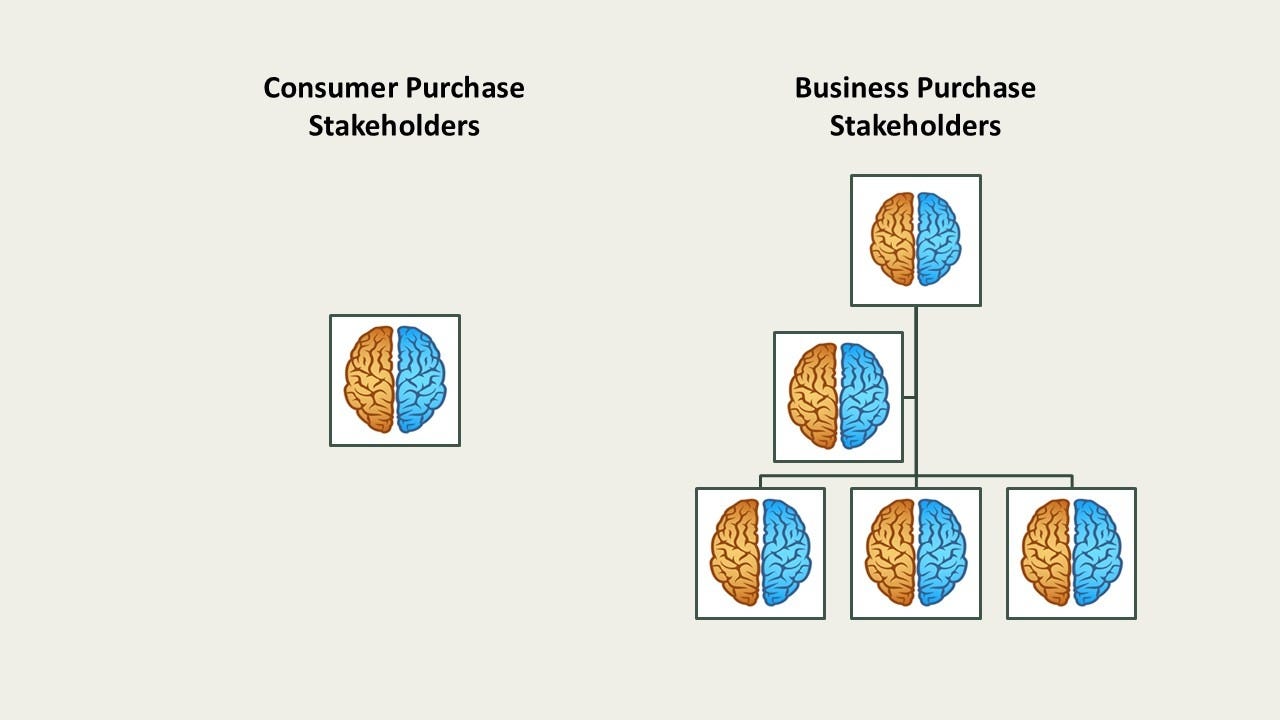
Starting from the b2c (left side) again.
At the car dealership, Fred has full authority. Others may influence, but he is the ultimate decision maker. And for that reason, the car salesperson is laser focused on him in order to sign the contract. Those of us who’ve been in that situation know the feeling.
Now let’s compare that to the b2b (right) side.
Back at Fred’s company, the buying process for the new IT hardware is quite different. Like most b2b companies, they make major purchasing decisions by committee. Although the CFO signs off on the final purchase, it is only with the input of other functional stakeholders. In this case that would be the company’s senior procurement manager, the VP of engineering, and of course, Fred who has served as the company’s official point of contact/legman for this project.
Each stakeholder has their own functional perspectives.
The senior procurement manager who reports to the CFO is partial to the existing vendor because they have had a long standing relationship, gets great pricing and is easy to work with from a contracting and billing perspective. His attitude is “if it ain’t broke, don’t fix it.”
The engineering VP has been pressing hard for a change in vendor to better support their increasing network demands. He feels the current vendor has lost its technical edge and is in decline.
Fred, whose team provides first tier technical support, has recently had his hands full with multiple issues caused by the existing hardware. He likes what the new vendor has to offer but is concerned about possible migration risks.
The new vendor’s hardware is premium priced and has thus far resisted matching the discounts of the incumbent vendor. Instead the sales representative provided Fred a detailed business case showing a high ROI. Fred is hesitant to forward that to the CFO because he worries she’d be highly skeptical of it – he may lose credibility.
Fred will delay his recommendation a bit while he gets more input from other stakeholders.
Does this story sound familiar to you? It certainly follows a general plot line I’ve seen before.
What it means
First, if you operate in the b2b space, one mistake you should definitely avoid is assuming that your customer behaves like a consumer.
This is the main reason why I have such a dim view about quantitative willingness to pay studies like conjoint analysis. These methods are designed for consumer products, where the consumer is both the user and the decision maker and brand names are relevant. This is simply not the case for many b2b products.
Qualitative research is a better and more affordable approach for b2b. To read more about this topic see:


Some of my fellow pricing experts go even further and advise skipping the market research and test/refine pricing directly during the sales process itself!
Second, value-based pricing does not work for most b2c products. Theoretically it should work for big ticket purchases like cars and homes, but often right-side emotions dominate. The exceptions where I’ve seen value selling work is for certain home renovation projects like solar panels or heat pumps.
However, value-based pricing is a great fit for b2b products that are highly differentiated, such as the new hardware vendor at Fred’s company. It may also work for the incumbent vendor too, but more than likely the procurement manager will end up squeezing them for another discount.