
Why It’s Important to Validate Customer Value
I can give you at least two good reasons


Last week I met up with the good folks at the Pricing Tribe. The Pricing Tribe is a new online community of pricing professionals led by Karan Sood. I highly recommend anyone in the pricing field who wishes to network with worthy peers to check it out.
They invited me to talk about how I validate customer value. As far as I know, I’m one of the few who does this type of work. At least I think I am – if you know others who do please leave me a message or comment below.
Why Should We Even Bother?
I started the discussion by asking why we should even bother to validate the value which our customers get from using our products and services. Not surprisingly, the Tribe quickly provided very good reasons, such as:
To set good prices (of course I’d expect a pricing pro to say that!)
To evaluate price changes over time (another good one!)
To inform the product roadmap (as a former product manager, I really appreciate that one!)
My two reasons are these:
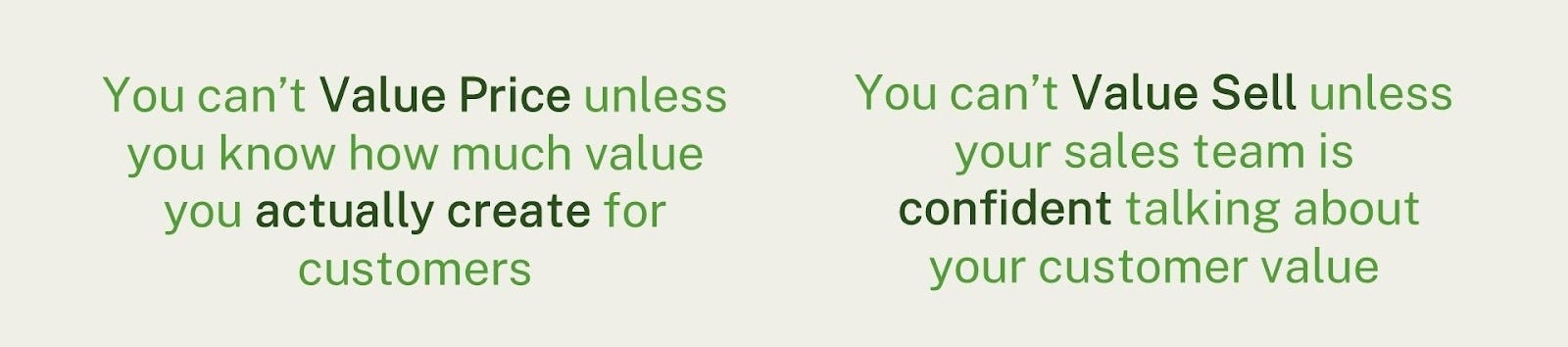
The first reason is fairly obvious and already noted above. As I would expect, some Tribe members do make value estimates. Unfortunately that is as far as many companies go. Which means that value pricing is at the mercy of the sales team and most likely a dead end.
Which brings us to reason #2.
Simply stated, if the sales team has little reason to believe in the value of a product they will not try to talk about value with customers. Customers are highly skeptical of value-based claims because of the proliferation of bogus ROI claims. So if the value case can’t be explained confidently then the sales discussion soon morphs into price negotiation and discounts.
Naturally these two reasons are interconnected. Validating customer value provides the proof-points that make the sales team confident in talking about value.
And the only way to validate customer value is by doing qualitative customer research, namely customer interviews.
Customer interviews should be done as part of a regular Voice of the Customer (VoC) initiative that is owned by the product team and/or customer success team. The interviews themselves can be done by them or a third party. Anyone except the sales team. Reason: VoC initiatives establish an independent, objective source of truth about customers. This includes understanding their willingness to pay (WTP).
Qualitative customer value interviews are a very reliable way to test WTP. I would argue they do a better job than quantitative pricing studies.
The Customer Research Plan
Here is the process that I follow to validate customer value. It has three phases.
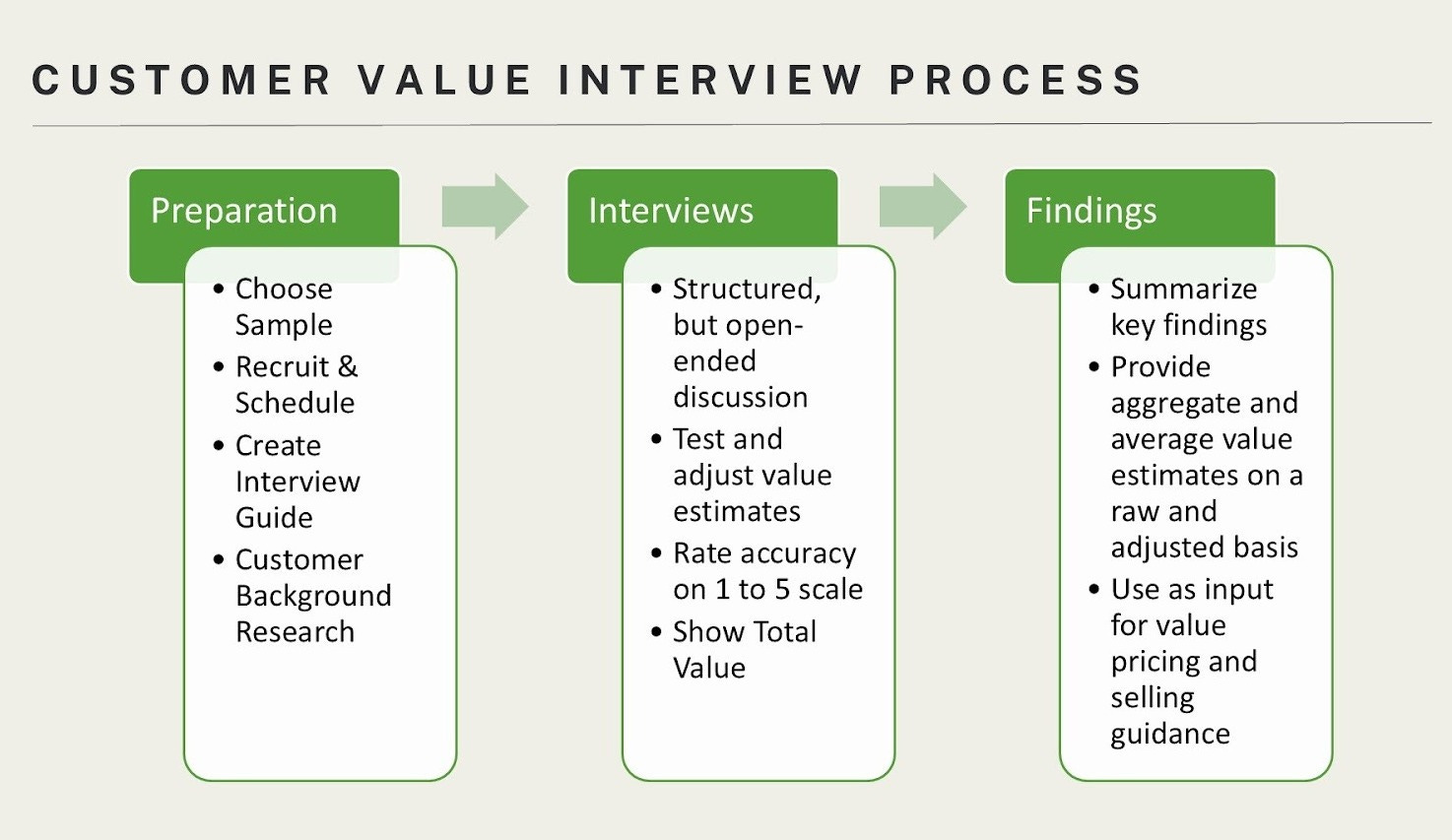
Phase 1 - Preparation
Just as for any good market research project, preparation is key.
I recommend a minimum of 3 to 5 completed interviews per segment or ICP (ideal customer profile). The sample should be made up of companies that have either direct experience using your product, so existing customers and former customers including trial/pilots. Usually I will talk with one key stakeholder per customer although more complex solutions may require multiple stakeholder interviews.
When recruiting it is important to set clear expectations that this is positioned as VoC research and NOT sales. Nor would I position it as a pricing study. It should be described as an interview to listen to their feedback about how the product/ service provides value to their organization, as well as other feedback about customer satisfaction.
The interview guide should be designed for a 45 minute structured discussion. The main topic is customer value validation and this takes about 20-30 minutes. Other topics can include the customer stakeholder’s goals, needs and challenges as well as feedback about their level of satisfaction. It can also include feedback about the product roadmap and packaging.
Always do background research on the company using internal and external sources. This is necessary to show initial value estimates that the customer can react to. If specific data is not available use proxies or industry average or even your/sales team’s best guess.
Phase 2 - Interviews
Below are example screenshots from a typical interview. This example is loosely based on a past study. Here the product is a predictive maintenance sensor used in hydraulic pumps for very large water and sewer systems.
In this particular value driver, we are estimating the cost of emergency repairs at critical site installations. The top green box highlights key customer inputs that estimates the customer’s current annual expected cost.
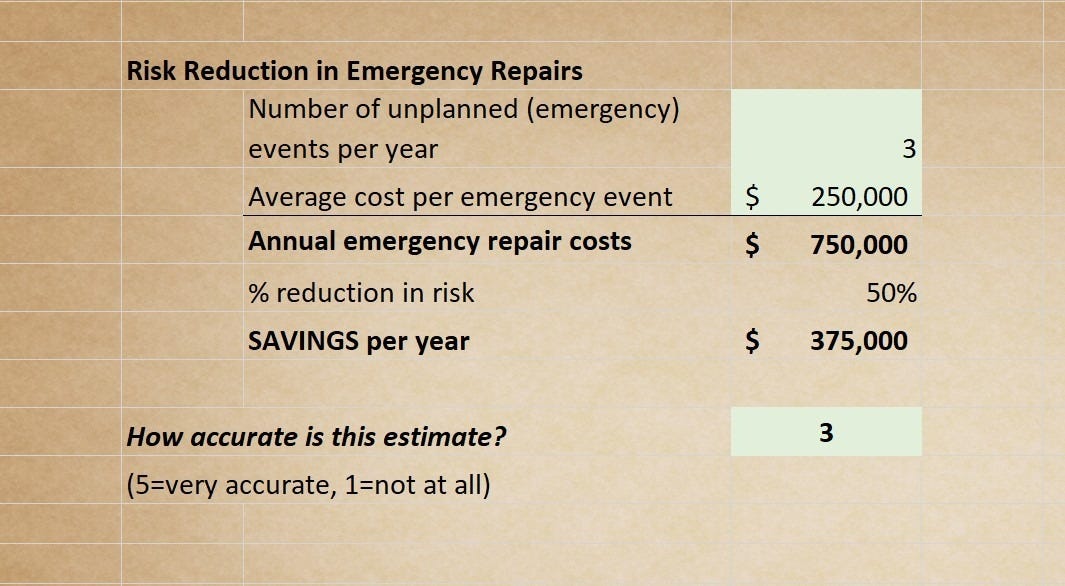
During the interview, I will ask the customer stakeholder if they would like to change my inputs for “Number of unplanned (emergency events per year” and “Average cost per emergency event.” Usually they do which in turn updates the “Annual emergency repair costs.” What is important to realize here is that we have effectively quantified the cost of the customer’s problem, and in this case it is a significant 6-digit problem.
Most likely this is the first time the customer has ever seen a dollar estimate to the size of this problem. This reveal is both eye opening and at the same time validates a real customer concern they long had in their gut. Now it has a number based on clear logic and their own inputs.
Next, I get the customer’s reaction to the “SAVINGS per year” estimate. This is based on a 50% risk reduction because of having predictive maintenance sensors, a claim that the product team stands behind.
Specifically I’ll ask the customer to rate the accuracy of the savings estimate on a 1 to 5 scale, where 5 equals very accurate and 1 equals not at all. If the rating is low I’ll probe into the reasons why they feel that way. Most often it is because they are being naturally cautious. In this situation I’ll offer to lower the 50% claim to what they feel is reasonable. Once that is done, I’ll ask them to again rate the accuracy of the savings.
Then I move onto the next value driver. A typical interview has somewhere between five and ten value drivers to test. One of the goals of this research is to discover the best and the biggest value drivers, the 1 to 3 that account for 80% of the value your product creates for customers and which your sales team should be trained to talk about.
Having done over a hundred interviews like this, I find that most customers react positively to having value discussions like this and feel it is an effective way to make a business case. To read more see.
Phase 3 - Findings
Once interviews are completed, the final step is to summarize the findings in a presentation. For the customer value validation section, the key part is to show the value estimation averages for each individual value driver on both a raw and adjusted value basis. The figure below illustrates how this works using the previous customer example.
On the left you see three value drivers that were tested including the risk reduction driver from above. The total savings per year for this customer amounts to $825,000. Since this figure does not factor in the customer’s accuracy ratings, I refer to this as the raw total.
The adjusted value amounts are to the right of the raw amounts. So for example, the adjusted value for the risk reduction value driver is $187,000 which is half of the raw value. This is because the customer had given it a 3 rating in accuracy on a 1 to 5 scale. The value adjustments are as follows: 1=0%, 2=25%, 3=50%, 4=75% and 5=100%
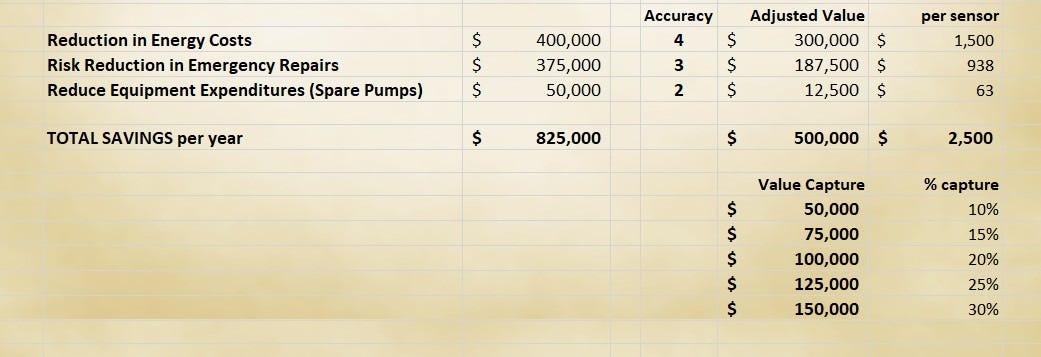
Note that the total adjusted value for this customer is $500,000, which is significantly less than the raw total of $825,000. I use the lower adjusted value number as the basis of the value pricing recommendations.
On the bottom right you see what this more conservative figure is worth at different levels of value capture. Should the other customer interviews in the segment/ICP follow a similar pattern, then average ACVs (annual contract value) may be able to increase somewhere between $50K-$100K which is 10%-20% of the value that the customer agreed was created for them.
At the bare minimum it should curtail discounting.
This of course would be highly dependent on the sales team’s success in making convincing value cases. However, this research provides the essential social proof of value that sales people require to be confident in making them.
Very good review of the process you have developed and refined over the years. All companies need to be doing some form of this. AI is not a substitute for this but it can be an enabler.
I love this thought process, Ed. It's a great technique to bring perceived value closer to real value, for both current and new customers. I wonder if the reason many companies don't do this is that they are afraid they aren't delivering real value.